🔒 Hello, this is Valentina with a premium issue of the Optivem Journal. I help Engineering Leaders & Senior Software Developers apply TDD in Legacy Code.
You went straight into microservices because… well, everyone else was doing it.
“Scalable.”
“Cloud-native.”
“Future-proof.”
“Independent deployments.”
Suddenly there are:
12 services
14 repositories
RabbitMQ
Kafka
Kubernetes
…before you even fully understand the domain.
❌ The Distributed Monolith Trap
You are guessing domain boundaries, so microservice boundaries based on your guesses.
The problem is you discover, during the next months, that you’ve modelled the domain in the wrong way. You discover that your microservices are too tightly coupled, and to implement a simple User Story, you have to coordinate changes across multiple microservices. Changes become expensive.
Immediately jumping to microservices — especially the wrong microservices — is expensive to build and expensive to run.
You can call it “microservices”…
…but it’s just a distributed monolith.
⚠️Fear of the Monolith
Some developers hear “monolith” and imagine:
massive bloated classes
tangled dependencies
painful future migrations
But not every monolith has to become a “big ball of mud.”
🚀 Register now: ATDD – Acceptance Testing Workshop
Get 100 EUR off with code DISCOUNT_100
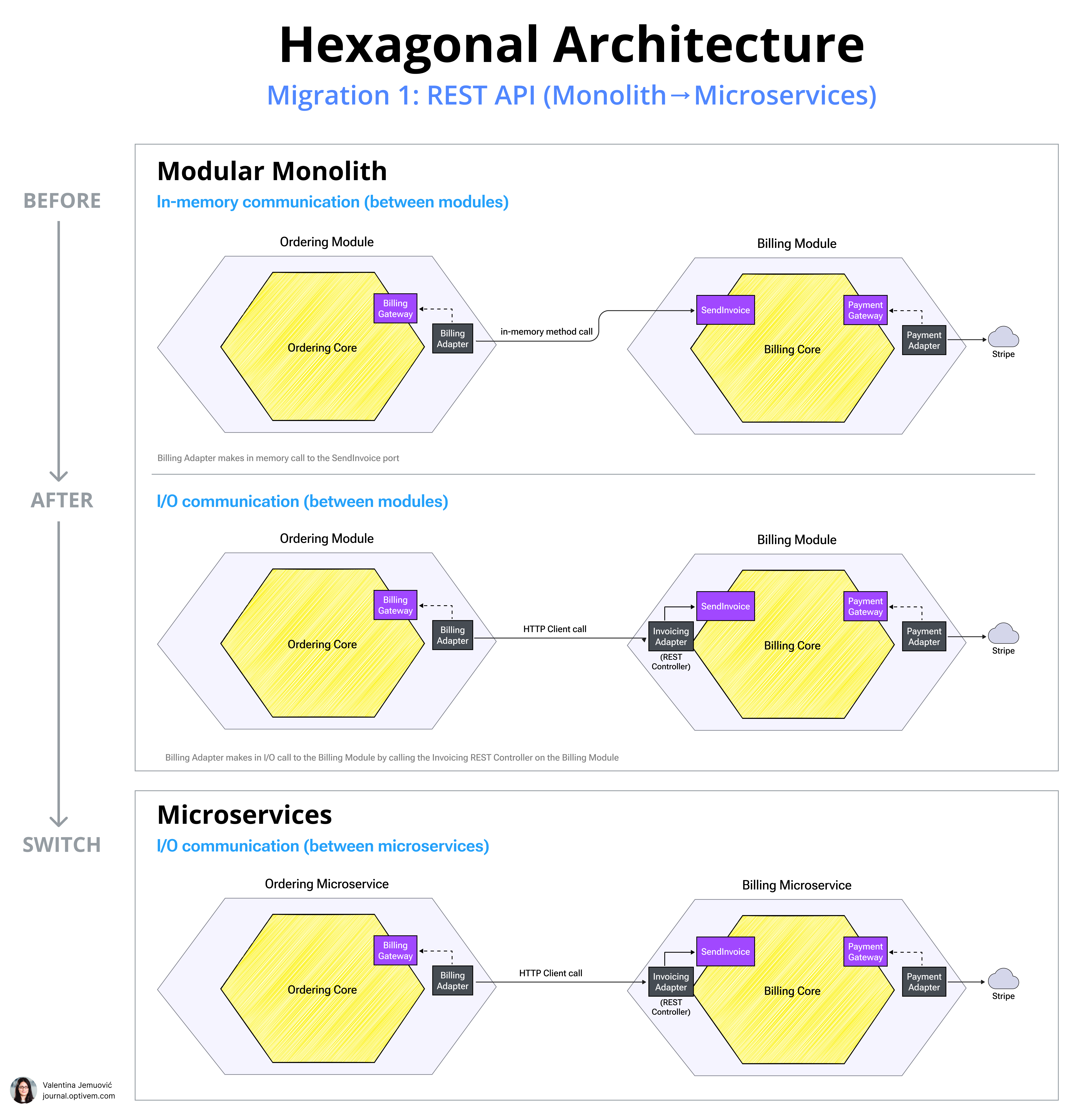
Hexagonal Architecture Inside the Modules
Modular Monolith → all the modules are deployed as a single artifact
Microservices → each microservice is deployed independently