

👋 Hello, this is Valentina with the free edition of the Optivem Journal. I help Engineering Leaders & Senior Software Developers apply TDD in Legacy Code.
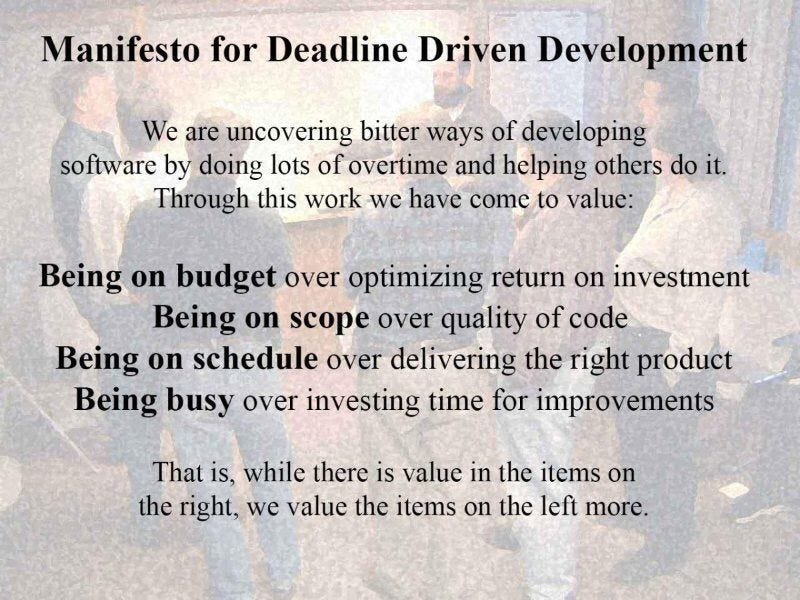
Manifesto for Deadline Driven Development
We are uncovering bitter ways of developing
software by doing lots of overtime and helping others do it.
Through this work we have come to value:
Being on budget over optimizing return on investment
Being on scope over quality of code
Being on schedule over delivering the right product
Being busy over investing time for improvements
That is, while there is value in the items on
the right, we value the items on the left more.
—Source: Unknown
Unfortunately, this is still too common in fake Agile development.
You Can’t Be Agile Without Technical Practices
Agile isn’t just about daily stand-ups, story points, or hitting deadlines. Without strong technical practices, it becomes fake Agile — a sprint-to-sprint survival game.
Consider these realities:
No TDD or automated tests → every code change is a risk. Bugs slip into production, releases become slow and stressful, and the team spends more time firefighting than delivering value.
Messy, unmaintainable code → without clean code principles, adding new features takes exponentially longer. Refactoring becomes a nightmare, slowing down every iteration.
Skipping continuous integration → you can’t safely ship small, incremental changes. Releases are big, risky, and infrequent, which contradicts Agile’s goal of rapid feedback.
Agile promises fast feedback, adaptability, and incremental delivery.
But without tests, clean code, refactoring, and CI/CD, you lose the safety net that makes those promises possible.
In short: no tests, no quality, no real agility. You can run sprints, but you’re running blind.
Source: Unknown
Well, you may “appear” to be agile without TDD or tests during the first 3-6 sprints. You’re hitting deadlines, stories are done, and the team feels productive.
But soon after, cracks start to show:
Adding new features takes longer because you’re afraid of breaking existing functionality.
Bugs creep into production, slowing down releases and users are getting frustrated.
Refactoring becomes risky, so code quality degrades over time.
Without TDD you don’t have the confidence to change code, refactor, and deliver continuously without fear. Quality degrades as regression bugs accumulate.
Without ATDD you risk building a system that fails to satisfy business requirements, whereby there's misalignment between developers and QA regarding requirements, causing expensive rework. Furthermore, without ATDD, your team is most likely having to resort to manual QA regression testing, leading to delivery delays and regression bugs escaping to production.
ATDD means that, given some requirements, we convert requirements (acceptance criteria) into executable requirements (acceptance tests), before we start coding. After coding is done, the acceptance tests help verify whether the system behaves as expected (whether acceptance criteria is satisfied).
ATDD enables the whole team to reach alignment regarding requirements, before development starts. Furthermore, acceptance tests simultaneously serve as regression tests. Developers then work under less stress and avoid overtime.
🚀 Join the ATDD Accelerator waitlist
Deadline Driven Development – definitely a trap too many teams fall into! Skipping TDD and ATDD means your system is always breaking and it feels impossible to fix.
Hi Valentina,
I appreciate your work promoting modern engineering practices and agree wholeheartedly on their power. However, I believe widespread industry adoption remains significantly slow.
I observe that the challenge isn't technical; it's organizational and educational. Developers often lack this training from universities or employers, leading to a reliance on individual drive (e.g., through channels like Tech Excellence) or the foresight of a few companies to provide a learning budget.
My central hypothesis is that this slow adoption stems from a failure to translate "Engineering Excellence" into a clear, compelling business case for top-level decision-makers.
The DORA/Accelerate metrics provide excellent general statements, but they don't give a board or CEO the specific, calculated ROI needed for investment approval.
I propose that the community needs an exemplary, quantifiable model.
Have you considered developing a case that directly compares the total cost of ownership (TCO) for a project:
Team A (fewer, highly skilled developers) vs. Team B (more, average developers).
Calculating the long-term ROI on dedicated coaching/training investments.
Such a document, based on a credible model, could be the key to unlocking executive buy-in.
Thank you for your thoughts on this interesting problem.
Best regards from Switzerland,
Peti in collaboration with Gemini Flash 2.5